Visuals
The market
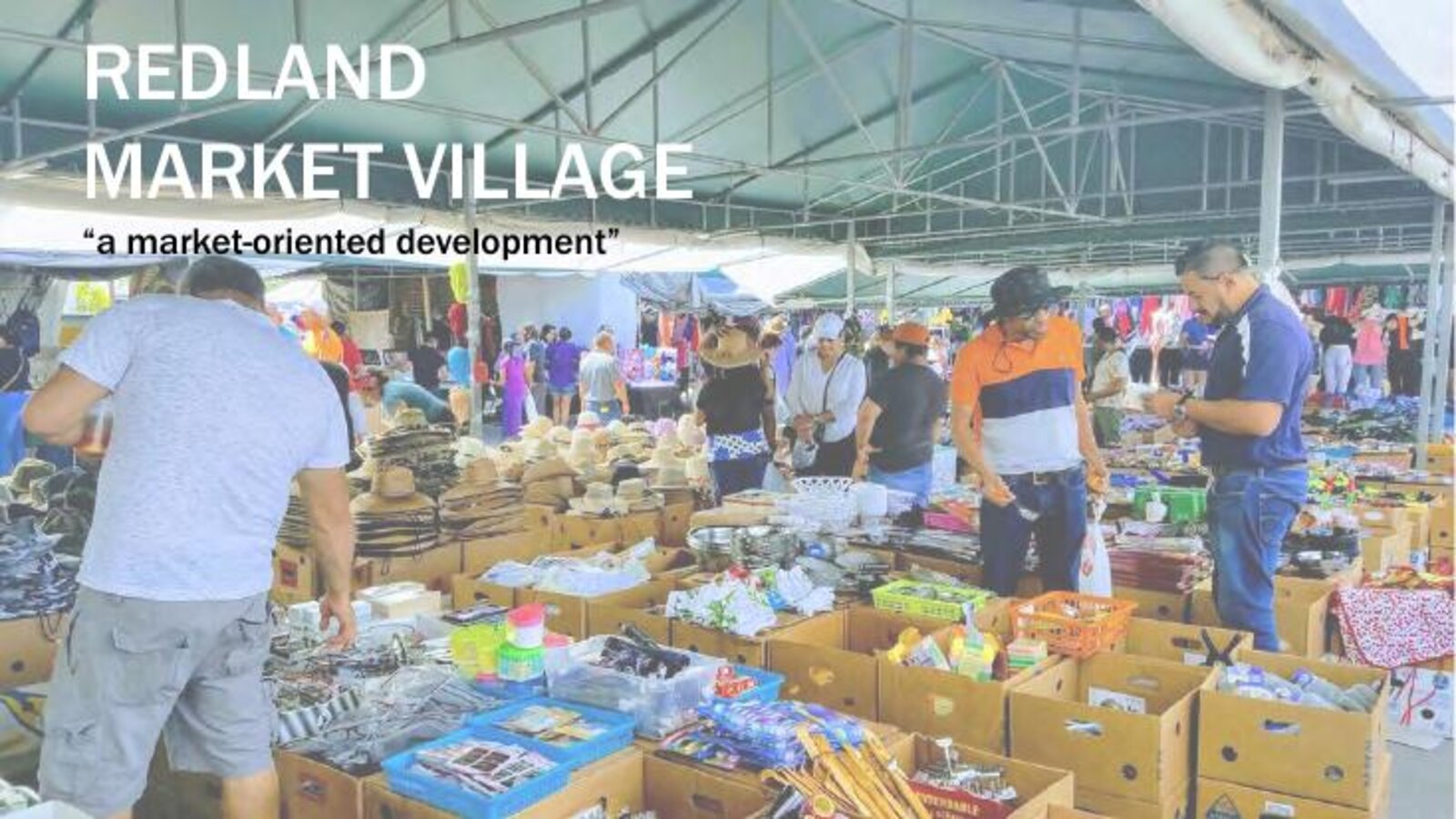
Turning South Dade's beloved farmers and flea market into a transit-oriented downtown — backed by a market study, a phased masterplan, and a public-financing strategy that asks for zero up-front grant dollars.
Redland Market Village has anchored South Miami-Dade since 1988 — an indoor farmers market, outdoor flea market, fish market, plant nursery, and food-truck row that draws more than 30,000 visitors a week and supports 442 entrepreneurs and roughly 850 jobs. BusinessFlare® was engaged alongside Dover, Kohl & Partners and Locus Architecture to help translate that living market into a phased, transit-oriented masterplan — and to prove it works on the numbers.
BusinessFlare® led the market and financial feasibility and shaped the public-financing strategy: a phased build-out along the US-1 corridor, connected to Bus Rapid Transit and the 244th Street Mobility Hub, funded through a tax increment financing (TIF) approach that recaptures a share of the new tax base the project itself creates rather than relying on up-front public grants.
Preserve the market as the real 'downtown' of unincorporated South Dade, then build around it — a walkable Main Street, mixed-income housing, expanded food and market halls, and a direct link to transit — financed by capturing a slice of the future tax growth the investment generates, so the public contribution is tied to value the project actually delivers.
Three connected workstreams — the masterplan, the feasibility case, and the public-financing strategy.
Working with Dover, Kohl & Partners and Locus Architecture, the plan keeps the market operating while adding a pedestrian Main Street, structured parking, and mixed-use blocks in phases — anchored to Bus Rapid Transit and the 244th Street Mobility Hub.
BusinessFlare® tested the fundamentals — real estate supply, market demand, workforce access, and financial viability — using trade-area analysis (Placer.ai) reaching 7.1 million people within a 1.5-hour drive.
Rather than asking for cash grants, the strategy proposes recapturing a share of the new tax increment the development generates, aligning public support with realized value and community benefits secured through the CRA.
The feasibility case quantified the community payoff — construction-phase activity, permanent job preservation and creation, and ongoing local spending — to support the public-financing request.
The plan was structured against the CRA's eligibility and evaluation criteria, pairing housing and jobs with transit, sustainability, and local-hiring commitments.